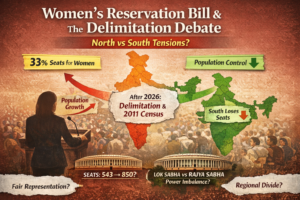
The Women’s Reservation Bill, officially known as the Nari Shakti Vandan Adhiniyam, has been widely welcomed as a historic step toward gender equality in Indian politics. The bill proposes reserving 33% of seats for women in the Lok Sabha and State Legislative Assemblies. However, despite its progressive intent, the bill has sparked significant debate across the country—particularly around its connection to delimitation and its potential impact on regional representation.
A key reason for the controversy is that the reservation will not be implemented immediately. Instead, it will come into effect only after a process called Delimitation. Delimitation involves redrawing constituency boundaries and reallocating seats based on population changes. This linkage has raised concerns because delimitation itself is a politically sensitive issue in India.
To understand the concern, it is important to look at history. For decades, the number of Lok Sabha seats allocated to each state has been based on the 1971 census. This arrangement was maintained through constitutional amendments such as the 42nd Constitutional Amendment Act and later extended by the 84th Constitutional Amendment Act. The purpose was to ensure that states which successfully controlled population growth—mainly in South India—did not lose political representation.
However, after 2026, this freeze is expected to end. Delimitation may then use more recent population data, such as the 2011 census. This shift could significantly change the balance of representation in Parliament. States with higher population growth, particularly in North India, are likely to gain more seats, while states with lower growth may see their share decline in relative terms.
This has led to a growing perception of a North–South divide. Southern states like Tamil Nadu and Kerala, which have implemented effective population control measures, worry that they may lose influence in national decision-making. At the same time, northern states such as Uttar Pradesh and Bihar, with larger populations, could gain greater representation.
The issue also extends beyond the North–South dynamic. Smaller states, especially in the North-East, have expressed concerns about being further marginalized if larger states dominate the Lok Sabha. Since the Lok Sabha is based on population, an increase in its size—from 543 seats to potentially around 850—could amplify the influence of more populous states.
This raises another institutional concern: the balance between the Lok Sabha and the Rajya Sabha. While the Rajya Sabha represents states, the Lok Sabha holds greater legislative power in most cases. If Lok Sabha representation becomes even more population-driven, the overall balance of power within Parliament could shift.
Government leaders have stated that no state will be disadvantaged and that fair representation will be ensured. However, critics argue that such assurances are not clearly detailed in the legislation, leaving room for uncertainty.
In conclusion, while the Women’s Reservation Bill marks a significant step forward for gender representation, its linkage with delimitation has made it part of a broader debate. The issue is no longer just about reserving seats for women—it is about how political power is distributed across regions in a diverse and federal country like India.
About The Author
