A severe early-season heatwave has gripped India in April 2026, with temperatures soaring up to 46°C across northern, central, and eastern regions. This extreme weather event is linked to the developing El Niño phenomenon in the Pacific Ocean. Scientists warn that rising sea surface temperatures—possibly evolving into a “Super El Niño”—are disrupting global climate systems. But what exactly is El Niño, why is it causing such intense heat in India, where is it originating, and how does it influence Indian weather patterns? The answer lies in large-scale ocean-atmosphere interactions that alter wind systems, weaken monsoons, and intensify heatwaves across the subcontinent.
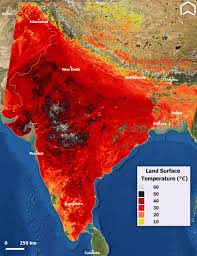
Rising Temperatures Map: India under the influence of El Niño-driven heat.
What is El Niño? (Geographical Explanation)
El Niño is a climatic phenomenon characterized by unusually warm sea surface temperatures in the central and eastern Pacific Ocean, particularly along the equator. Under normal conditions, trade winds blow from east to west, pushing warm water toward Southeast Asia and allowing cooler water to upwell near South America.
However, during El Niño, these trade winds weaken or reverse. As a result:
- Warm water spreads eastward across the Pacific.
- Upwelling of cold water is reduced.
- Atmospheric pressure patterns shift, altering global weather systems.This change is part of the larger El Niño–Southern Oscillation (ENSO) cycle and has far-reaching climatic consequences.
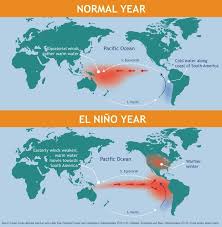
Pacific Ocean Shift: Normal vs El Niño Conditions and Their Impact on India.
How El Niño Affects India
India’s climate, especially the southwest monsoon, is closely tied to ocean temperatures and atmospheric circulation. El Niño disrupts this balance in several ways:
Weakened Monsoon Winds
The southwest monsoon depends on temperature differences between land and ocean. El Niño reduces this gradient by warming the Pacific, which weakens moisture-laden winds reaching India. This often results in:
-
- Delayed monsoon onset
- Reduced rainfall
- Uneven distribution of precipitation
- Intensified Heatwaves
With less cloud cover and rainfall, solar radiation directly heats the land surface. Regions like Delhi, Uttar Pradesh, and Punjab experience prolonged dry spells, leading to extreme heat conditions exceeding 42–46°C. - Agricultural Stress
Reduced rainfall and high temperatures affect crop cycles, soil moisture, and water availability. This can lead to:- Lower crop yields
- Increased irrigation demand
- Risk of drought conditions
The Threat of a “Super El Niño”
Meteorologists warn that 2026 could witness a “Super El Niño,” where sea surface temperatures rise more than 2°C above average. Historically, such events (like those in 1982–83 and 1997–98) have caused:
- Record-breaking global temperatures
- Severe droughts in India
- Disruptions in food production and water resources
A stronger El Niño amplifies atmospheric instability, making weather patterns more extreme and unpredictable.
Role of the Indian Ocean
In addition to the Pacific, the Indian Ocean is warming rapidly. This creates a dual impact:
- It intensifies local heatwaves by increasing humidity and temperature.
- It can further weaken monsoon circulation by disturbing pressure systems.
This combined oceanic warming acts as a feedback mechanism, worsening climate extremes in India.
The ongoing heatwave in India is not an isolated event but part of a larger global climate interaction driven by El Niño in the Pacific Ocean. As ocean temperatures continue to rise, the risks of extreme heat, weak monsoons, and agricultural stress increase significantly. Understanding these geographical processes is essential for climate preparedness, policy planning, and sustainable resource management. With the possibility of a “Super El Niño,” India must strengthen early warning systems, adapt agricultural practices, and develop strategies to cope with intensifying climate variability.
About The Author
