In an increasingly interconnected world, nations are not judged only by economic or military strength, but by their cultural appeal and global influence—what experts call “soft power.” Countries like South Korea have successfully transformed their global image through K-pop, K-dramas, and cuisine, while Japan has long promoted its culture through anime, discipline, and societal values. Even China, despite political criticism, uses platforms like cultural storytelling, C-dramas, and creators such as Li Ziqi to project a peaceful, traditional image. Even in a tightly controlled digital environment where platforms like YouTube are restricted, China has found powerful ways to project its culture globally. A striking example is Li Ziqi, who became an international phenomenon despite these limitations. India, with its vast cultural wealth, stands at a similar crossroads—capable of reshaping its global perception through stronger soft power focus.
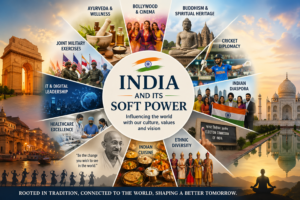
India already possesses a rich base of soft power elements.
India and Its Soft Power
India’s soft power lies in its ability to influence the world through culture, values, and lived experiences rather than force. Unlike many nations that build soft power through a few focused exports, India’s strength is its diversity—spanning spirituality, cinema, food, governance, and global connections. The challenge is not lack of assets, but how effectively they are nurtured and projected.
Ayurveda & Wellness Tradition
India’s ancient healing system, Ayurveda, along with yoga, is already globally respected. It represents a holistic lifestyle rooted in balance and prevention.
How to strengthen: Standardize practices, promote certified wellness tourism, and integrate Ayurveda with modern healthcare branding.
Bollywood & Film Industry
Hindi cinema has long carried Indian stories worldwide, shaping perceptions through music, drama, and emotion.
How to strengthen: Invest in global distribution, subtitles, and collaborations to reach wider audiences beyond diaspora markets.
Buddhism & Spiritual Heritage
Buddhism connects India spiritually to East and Southeast Asia, reinforcing its identity as a land of peace and enlightenment.
How to strengthen: Develop Buddhist tourism circuits and international cultural exchanges.
Cricket Diplomacy
Cricket is more than a sport in India—it’s a cultural connector across nations.
How to strengthen: Use cricket leagues and tournaments for cultural diplomacy and youth engagement globally.
Indian Diaspora
The Indian diaspora acts as informal ambassadors, spreading culture, cuisine, and values worldwide.
How to strengthen: Engage diaspora communities in cultural promotion and policy advocacy.
Democracy & Institutions
India’s democratic framework, supported by bodies like the Election Commission of India, builds global credibility.
How to strengthen: Showcase transparent governance practices and electoral expertise internationally.
Ethnic Diversity
India’s languages, traditions, and identities form a mosaic unmatched globally.
How to strengthen: Promote regional cultures equally, not just mainstream narratives.
Indian Cuisine
From spices to street food, Indian cuisine is one of the most diverse in the world.
How to strengthen: Brand regional cuisines globally and support international food festivals.
Gandhian Philosophy
Mahatma Gandhi symbolizes non-violence and moral leadership.
How to strengthen: Promote his ideas through education, diplomacy, and global peace initiatives.
Healthcare & IT Sector
India’s affordable healthcare and strong IT industry attract global trust and collaboration.
How to strengthen: Expand medical tourism and position India as a global tech innovation hub.
Joint Military Exercises
India’s participation in joint exercises reflects cooperation and trust-building.
How to strengthen: Highlight these as symbols of peace and strategic partnership rather than power projection.
However, these strengths are not always strategically projected. In contrast to South Korea’s deliberate promotion of its entertainment industry, India’s soft power often grows organically rather than through structured global outreach. This is where India must shift—from passive influence to active branding.
Emerging Soft Powers of India
India’s soft power is evolving beyond traditional pillars.
- Regional Cinema Boom: Films like Baahubali have shown that Indian storytelling can achieve global scale.
Development strategy: Invest in pan-India and global releases, dubbing, and OTT platforms. - Digital Creators & Post-COVID Content Growth: Independent creators are showcasing local culture, travel, and traditions worldwide.
Development strategy: Support creators with funding, training, and global exposure. - Tourism Through Geography & Culture: India’s landscapes—from Himalayas to backwaters—offer unmatched diversity.
Development strategy: Build strong visual storytelling campaigns highlighting real experiences. - Traditional Arts & Crafts Revival: Handloom, handicrafts, and folk arts are gaining global appreciation.
Development strategy: Connect artisans to global markets via e-commerce and branding.
Emerging soft power trends offer new opportunities. The global success of South Indian cinema, particularly films like Baahubali, has redefined international perceptions of Indian storytelling. Post-COVID, digital platforms have amplified Indian content, regional music, and independent creators, allowing diverse narratives to reach global audiences. Indian cuisine, festivals, and tourism potential—rooted in its varied geography and traditions—are also gaining renewed interest.
To strengthen its soft power, India must invest in cultural exports, support creative industries, and build a cohesive global narrative. Promoting regional diversity—not just a single “Indian identity”—can make the country more relatable and intriguing. Strategic use of digital media, international collaborations, and cultural diplomacy can amplify this reach.
About The Author
